
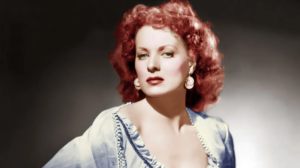
In celebration of Irish American Heritage Month, we are recognizing the economic, cultural, political, and social contributions of notable immigrants and refugees who’ve helped shape America’s vibrant tapestry. Today, we spotlight Hollywood Golden Age actress Maureen O’Hara.
Maureen Fitzsimons, later known as Maureen O’Hara, was born in Ranelagh, Ireland, in 1920. The second-oldest of five siblings, she credited her close-knit family — whom she described as an eccentrically remarkable tribe — for fostering her growth. Inspired by her mother, a former state and opera singer, O’Hara developed her vocal talents early, staging dramatic presentations at home and performing at school. In her teenage years, she studied drama and music at the Abbey Theatre School in Dublin. After graduation, she was offered leading stage roles but chose to pursue a career in film instead.
During an audition for an English film in London, O’Hara’s performance, although unsuccessful, caught the attention of the renowned producer and actor Charles Laughton. With his encouragement, she changed her last name and began her film career with a role in Alfred Hitchcock’s Jamaica Inn. Later in the same year, she signed a contract with RKO Studios and immigrated to the United States, settling in Los Angeles to make her American film debut in The Hunchback of Notre Dame.
Following O’Hara’s successful entry in mainstream Hollywood, she teamed with luminary director John Ford to depict the Welsh daughter of a working-class family in the drama How Green Was My Valley. The film won Oscars in five categories, most notably for both Best Picture and Best Actor.
The success launched Maureen’s career into the mainstream with a series of castings with Tinseltown’s leading men, including in The Black Swan alongside Tyrone Power and Bagdad alongside Vincent Price. In 1947, she was cast in the holiday classic, Miracle on 34th Street.
Over the next several years, O’Hara garnered the nickname “Queen of Technicolor” following a string of movies in which her natural features underscored the dynamic zeitgeist of Hollywood’s Golden Age, reflecting the technique used to create the highly saturated color that defined the era. During this time, she was also cast with film icon John Wayne in Rio Grande. The film’s success led the actors to pair up in a string of subsequent films, including The Quiet Man, The Wings of Eagles, McKlintock!, and Big Jake.
In the 1960s, O’Hara changed her focus to singing. She channeled the talent in television, records, and the Broadway production of Christine. Although she retired from film in 1978, she returned two decades later in the 1991 comedy, Only the Lonely. She continued acting through 2000.
In 2014, the Academy of Motion Pictures Arts and Sciences presented O’Hara with an honorary Academy Award in recognition of her seven decades on screen.
Offstage, she was the first woman to serve as president of a commercial airline. After her husband’s death, she took over the role of leading the company they both managed, Antilles Airboats.
Maureen O’Hara passed away in 2014.
Others we are celebrating in honor of Irish History Month:
Liam Neeson, award-winning actor
Augustus Saint-Gaudens, preeminent American sculptor