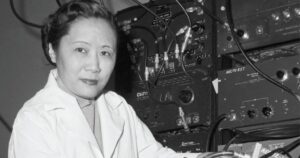
In honor of Women’s History Month, we recognize the economic, cultural, political, and social contributions of influential immigrant and refugee women who’ve helped shape America’s vibrant tapestry. Today, we spotlight trailblazing physicist Chien-Shiung Wu.
Wu was born in 1912 in Liuhe, China, the same year the Republic of China was founded. Her father, an intellectual and engineer, encouraged her to pursue the highest level of education she could, despite the exclusion of women from academia at the time. Wu’s father opened his own school, which she attended in her younger years. After graduation, she attended boarding school, where she graduated at the top of her class in 1929. Shortly after, she enrolled in the National Central University in Nanking, graduating in 1934 with a degree in physics.
Wu cited her mentor, Dr. Jing-Wei Gu, as her inspiration to study in the United States. She pursued nuclear physics at the University of California, Berkeley, where she worked in the Radiation Laboratory with physicist J. Robert Oppenheimer. Wu earned her Ph.D. in 1940. Afterwards, she received several teaching offers before joining Princeton as its first female physics instructor.
Due to ongoing tensions during WWII, anti-Asian sentiment on the West Coast was rising, prompting Wu to seek opportunities elsewhere. Wu was offered a position at Columbia University, where she joined the Manhattan Project. She officially became a naturalized U.S. citizen in 1954 and continued her research, specializing in beta decay. This research drew the attention of her male colleagues and Columbia, who asked for her guidance. With the help of Chien-Shiung Wu, these colleagues went on to receive a Nobel Prize in Physics in 1957. Although many referred to this research as the “Wu experiment,” she was not formally recognized for it. Wu took a permanent position at Columbia in 1958, focusing on sickle cell disease research for the remainder of her career.
Wu’s scientific contributions have had global impacts and have been recognized by many. She has received over fifteen major awards, notably the Comstock Prize in Physics, the National Medal of Science, and the Wolf Prize in Physics. Wu also served as the first woman president of the American Physical Society. Chien-Shiung Wu is regarded as the greatest Chinese female scientist of the twentieth century and is referred to as “the First Lady of Physics” and “Madame Wu.” Wu dedicated her retirement to encouraging other young women to pursue careers in science in both the U.S. and China. She passed away on February 16, 1997, and was buried in the courtyard of the school her father founded, where she attended as a young girl.
Others we are celebrating in honor of Women’s History Month:
2026
Theresia Gouw, trailblazing entrepreneur
2025
Cristeta Comerford, the White House’s first female executive chef and its first executive chef of Asian descent
Marlene Dietrich, renowned entertainer and activist
Azar Nafisi, critically acclaimed author and English Literature professor
Indra Nooyi, Forbes list business executive and trailblazer
Lea Salonga, Tony Award winning musical theater actress and Disney Legend
2024
Cecelia Payne-Gaposchkin, astronomer, educator, and trailblazer
Mother Cabrini, canonized Catholic sister and the patron saint of immigrants
Elisabeth Kübler-Ross, Psychiatrist and trailblazer for the acceptance of palliative care
Hinke Boot, former 20-year IIB Executive Director and advocate for New Americans
2023
Gloria Estefan, award-winning singer
Iman, supermodel and human rights activist
Isabel Allende, international best-selling author
Madeleine Albright, 64th U.S. Secretary of State, first woman to hold position
Martina Navratilova, tennis superstar and civil rights advocate
Mila Kunis, award-winning actress and humanitarian
Lidia Bastianich, Emmy award-winning celebrity chef
Hedy Lamarr, Hollywood “Golden Age” actress and modern tech luminary