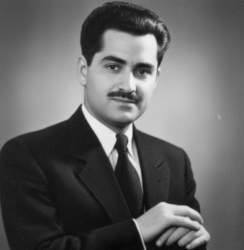
In honor of Arab American Heritage Month, we continue to recognize the economic, cultural, political, and social contributions of notable immigrants and refugees who’ve helped shape America’s vibrant tapestry. Today, we spotlight prolific inventor, Hassan Kamel Al-Sabbah.
Hassan Kamel Al-Sabbah was born in Lebanon in 1894. He displayed considerable intellectual abilities as a child. His commitment to his studies earned him admission to the American University of Beirut, where he excelled in mathematics and physics.
Though remarkably successful in his studies, the realities of World War I forced Hassan to alter his path. In 1916, he was conscripted into the Ottoman military, where he served as a telegraph operator. The experience introduced him to electrical communication, galvanizing his lifelong passion for electrical engineering.
Following the war, Al-Sabbah briefly returned to Beirut to teach mathematics. In 1921, he immigrated to the United States, where he studied at the Massachusetts Institute of Technology for a short time before enrolling at the University of Illinois. His remarkable aptitude as a student drew the attention of industry titan General Electric (GE). By 1923, he was employed at GE’s distinguished Schenectady Lab.
At General Electric, Hassan embarked on a flurry of creativity and invention. In just ten years, he filed 70 patents. The incredible pace yielded a plethora of inventions ranging from television parts to rectifiers that convert electricity from AC to DC currents.
His work even included early seed solar panel technology, a project he envisioned could inject life into parched, barren desert terrain. Among Al-Sabbah’s most substantial achievements was his pioneering work advancing television transmission. A central figure in the transformation of modern broadcasting, his novel research played a pivotal role in clarifying televised images.
Tragically, Hassan Al-Sabbah’s life was cut short in a fatal car accident in 1935, at the young age of 41. Though his immeasurable contributions to the world were cut short, his legacy still percolates through the roots of modern ingenuity. His groundbreaking research and inventions created the infrastructure for vital progress in the electronics field. Nearly a century after his death, his work continues to influence modern broadcast media and energy transformation.
Others we are celebrating in honor of Arab American Heritage Month:
Dr. Elias Zerhouni, award-winning actor
Rana el Kaliouby, scientist and entrepreneur
Laila Lalami, writer and educator