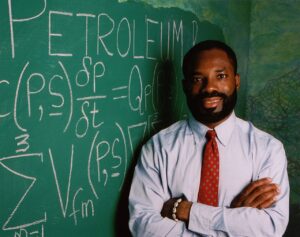
In honor of Black History Month, we continue to recognize the economic, cultural, political, and social contributions of influential Black immigrants and refugees who’ve helped shape America’s vibrant tapestry. Today, we spotlight trailblazing Nigerian American computer scientist, Phillip Emeagwali.
Born in Nigeria in 1954, Phillip Emeagwali mastered calculus by middle school, surpassing his instructors, but paused his schooling when the Nigerian Civil War began. At 13, he joined the Biafran army to protect the Igbo people and others from persecution.
Following the war, he independently completed high-school level education, believing intellect to be a path out of poverty. At 17, after completing a class at the University of London, he immigrated to the U.S. and completed a bachelor’s degree in mathematics on scholarship at Oregon State University. He went on to earn two master’s degrees in engineering from George Washington University. He also completed his master’s degree in mathematics from the University of Maryland and was accepted into a doctoral-level civil engineering program at the University of Michigan.
Emeagwali is most known for programming the Connection Machine. The novel technology integrated 65,000 computers to complete 3.1 billion calculations per second to solve an oil reservoir simulation. He also used it to model and explain complex scientific discoveries, such as how sperm swim, how polluted groundwater flows, how the Earth’s interior moves and causes volcanic eruptions, and how to recover petroleum in safer and larger quantities. The feat won him the prestigious Gordon Bell Prize in 1989.
He continued his groundbreaking work at the Army High Performance Computing Research Center, where he researched next-generation supercomputers to enable scientists to solve intricate problems in several fields, including meteorology and the environment. He also worked with the National Weather Service and the University of Michigan and is credited with designing the Hyperball computer for advanced weather forecasting.
In addition to the Gordon Bell Prize, Phillip Emeagwali has won the Pioneer of the Year and the Distinguished Scientist Award from the National Society of Black Engineers. He is widely recognized as one of the most accomplished African American inventors of the 20th century.
Others we have celebrated in honor of Black History Month:
2026
Delroy Lindo, British American and Academy Award-nominated actor
2025
Alix Idrache, Army captain and pilot
Michaela DePrince, standout soloist with the Boston Ballet and Dutch National Ballet
2024
Guetty Felin, Haitian-American documentary filmmaker
Hakeem Olajuwon, Nigerian-American NBA Hall of Famer and humanitarian
Claude McKay, Jamaican-American poet and Civil Rights advocate
Dikembe Mutombo, NBA Hall of Famer, and humanitarian
2023
Chimamanda Ngozi Adichie, award-winning author
Trevor Noah, award-winning author and television host
Wyclef Jean, three-time Grammy award-winning musician
Rep. Ilhan Abdullahi Omar, Somali American Congresswoman