
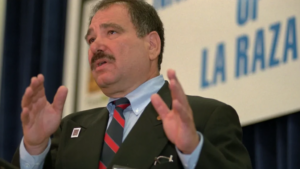
In honor of National Hispanic Heritage Month, we continue to recognize the economic, cultural, political, and social contributions of notable immigrants and refugees who’ve helped shape America’s vibrant tapestry. Today, we highlight award-winning reporter, Ruben Salazar.
Ruben Salazar was born on March 3, 1928, in Ciudad Juarez, Mexico. His father, a timepiece repairman, moved the family to El Paso, Texas, in 1929. There, a young Salazar eventually began attending public school.
Like many Mexican Americans, Salazar’s goals included attaining American citizenship, a process he began at 19 years old. One year later, he received a letter requesting an official naturalization petition. To bolster the process, he joined the army in 1950. In 1953, six years after his initial application, Ruben’s determination paid off when his naturalization petition was finally approved.
Salazar graduated in 1954 from Texas Western College with a bachelor’s degree in journalism. There, he developed skills as a writer and reporter while working for the student newspaper, The Prospector.
Following graduation, Salazar was hired by the El Paso Herald-Post. There, he quickly earned praise for his investigative reporting on issues such as prison conditions and drug trafficking. He often went undercover to expose harsh realities that marginalized communities faced.
Salazar’s early work shaped the foundation for his future achievements as a journalist and civil rights advocate. In 1959, Salazar joined the Los Angeles Times as a reporter. There, he covered a wide range of stories, including the city’s Mexican heritage. Later, he was promoted to foreign correspondent and was sent to cover stories in Asia and Latin America.
In 1970, following his time working overseas, Salazar penned an article on the importance of alleviating cultural misunderstandings between the Spanish-language press and the local police department.
Salazar was one of the first journalists to bring Mexican Americans to the front pages of the newspaper, though he faced scrutiny during the height of the Chicano civil rights movement.
In 1970, Salazar died after a sheriff’s tear gas canister struck him in the head while he was covering public Vietnam protests in Los Angeles. He was 42 years old.
Ruben Salazar’s work was recognized with a bevy of awards. They include a state medal for best local news coverage in California, a distinguished Alumnus Award, and the Robert F. Kennedy Journalism Award.