
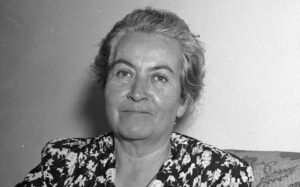
In honor of Hispanic American Heritage Month, we continue to recognize the economic, cultural, and social contributions of notable immigrants and refugees who’ve helped shape America’s vibrant tapestry. Today, we spotlight Chilean Nobel Prize-winning poet, educator, and diplomat, Gabriela Mistral.
Gabriela Mistral was born on April 7, 1889, in Vicuña, Chile. She was raised in a small village in Montegrande. Mistral attended a primary school, though when she was just three, her father abandoned the family. Poverty was a constant presence in Mistral’s early life. Her family’s financial struggles and relocations kept her from attending school regularly, but she worked hard to persevere. Though her mother worked as a seamstress, Gabriela began supporting the family at just 15 years old, while also working as a teacher’s aide.
Her early work came amid significant heartbreak. In 1909, her boyfriend, a railway worker, committed suicide. Shortly after, her second love left her to marry another. Gabriela channeled her experiences and gained recognition in 1914 for writing her book, “Sonetos de la Muerte” (Sonnets on Death). While publishing, she also worked as a teacher.
In 1921, Mistral served as principal of a new, prestigious school in Chile’s capital. There, she continued writing and publishing poems, articles, and other educational materials. To protect her anonymity, she wrote under the pseudonym “Lucila Godoy.”
In 1922, she moved to Mexico to help rebuild the Mexican education system following the perils of the Mexican Revolution. After leaving the country, Mistral continued to travel and share her work. In 1925, she became a secretary for the Latin American section of the League of Nations in Paris. Mistral also continued to travel and teach classes at various colleges, including Columbia University, Vassar, Barnard, and Middlebury College.
On November 15, 1945, Gabriela became the first Latin American to receive the Nobel Prize in Literature. One year later, she received Chile’s National Literature Prize. Critics praised her works for their themes of love, sorrow, nature, motherhood, and childhood.
In the last few years of her life, Mistral lived in New York and battled pancreatic cancer. She died from the disease in January 1957. She was 67 years old.
Others we are celebrating in honor of National Hispanic Heritage Month:
Pedro Pascal, award-winning actor
Ruben Salazar, award-winning reporter